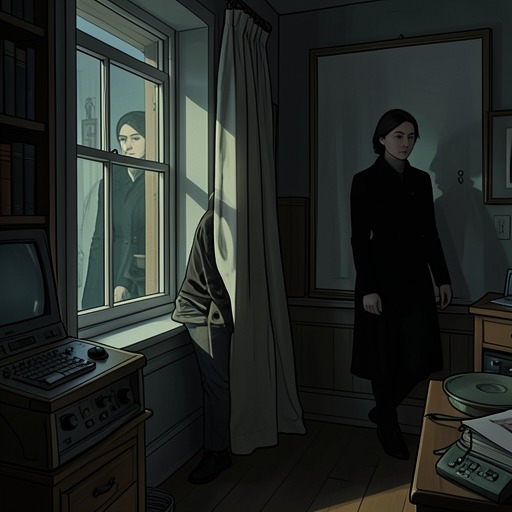
Oedipa Maas and Pierce Inverarity’s affair
The Crying of Lot 49Oedipa Maas and Pierce Inverarity’s affair is a past intimacy that becomes newly consequential after his death, when Oedipa’s investigation of the Tristero keeps converging on his property and possible designs. She cannot determine whether Pierce left her a coded inheritance, set an elaborate trap, or simply died while she had stumbled onto a real network; the affair thus persists as an unresolved contest between affection, possession, and interpretation.
The Relationship in the Wake of Pierce’s Death
Oedipa had been Pierce’s mistress, but the relationship did not make her a confidante of his business life. Looking back, she understands that the business-minded part of him had remained inaccessible to her, a fraction that would not come out even. Her love, such as it had been, could not be measured against his appetite for possession and for altering the land—bringing new skylines, personal antagonisms, and growth rates into being. The gap between intimacy and knowledge becomes central to her later effort to make sense of what he left behind.
Pierce’s will appoints Oedipa to deal with his estate, and the assignment draws her into a search whose apparent routes to the Tristero lead back to Inverarity property. She considers whether the will might contain a code even Pierce did not fully understand, written when he had been overtaken by some headlong expansion of himself or a lucid instruction. Yet she can no longer summon an image of the dead man to dress up, pose, speak to, and make answer. The practical task of administering his legacy therefore opens onto the absence of the person whose intentions she is trying to read.
Possession, Inheritance, and the Tristero
The accumulating connections make Pierce’s estate look less like a neutral setting for Oedipa’s investigation and more like a possible instrument of it. She considers whether people connected with the mystery—including Emory Bortz, Metzger, Cohen, Driblette, Koteks, the tattooed sailor in San Francisco, and the W.A.S.T.E. carriers she has seen—might all be Pierce’s employees, purchased allies, or willing participants in a grand practical joke. The possibility is frightening precisely because it would turn the scattered clues into an arrangement directed at her: a means of embarrassing, terrorizing, or morally improving a former mistress.
Oedipa also considers a less personal explanation: Pierce may have discovered the Tristero himself and encoded it in the will, buying into the network just enough to make sure she would find it. At the opposite extreme, the apparent conspiracy may be a way for Pierce to survive death in her mind, as a paranoia or a pure conspiracy against someone he loved. Her suspicion that his perversity might have outlasted him does not resolve into proof. Each interpretation makes the affair’s old imbalance newly legible, but none establishes what Pierce actually intended.
An Intimacy Without Resolution
The phrase Pierce once used to describe his secret—“Keep it bouncing”—returns to Oedipa as a measure of what may have stopped with his death. She wonders whether he wrote the will cynically, intending only to harass a former mistress because he was sure that nothing more could be salvaged; the bitterness, she thinks, might have run that deep. But she cannot know whether the will was an act of malice, an encoded invitation, or merely the surviving trace of a life whose business and motives she never fully shared.
That uncertainty prevents the affair from becoming a settled romantic memory or a solved motive. Oedipa feels a new compassion for the cul-de-sac Pierce had tried to escape and for the enigma his efforts created, even as she remains unable to decide whether he had found a way out or made the maze more elaborate. Her former love supplies neither reliable access to his intentions nor immunity from his possible manipulation. The relationship endures instead as a question embedded in the estate: whether anything she discovers there belongs to Pierce’s design, to the Tristero, or to her own attempt to give meaning to his absence.